
 |
Dates | December to March |
| Duration | 20 days |
|
| Grade | 1C | |
|
"Andes" Leadership Fee
(includes leaders expenses) About £2400 |
||
Easy High Altitude Mountaineering on the Volcanoes of Argentina.
RE-SCHEDULED FOR DECEMEBER 2021
PRICES & COSTS
All are per person.
"Andes" Leadership Fee (includes leaders expenses) -- About £2400
Estimated Airfares -- £1000
Estimated Trek & Travel Costs in Argentina -- £800
Estimated Accommodation & Meals -- £200
ESTIMATED TOTAL COST per person -- £4400
What's included in the price you pay ANDES and what's not.
INTRODUCTION
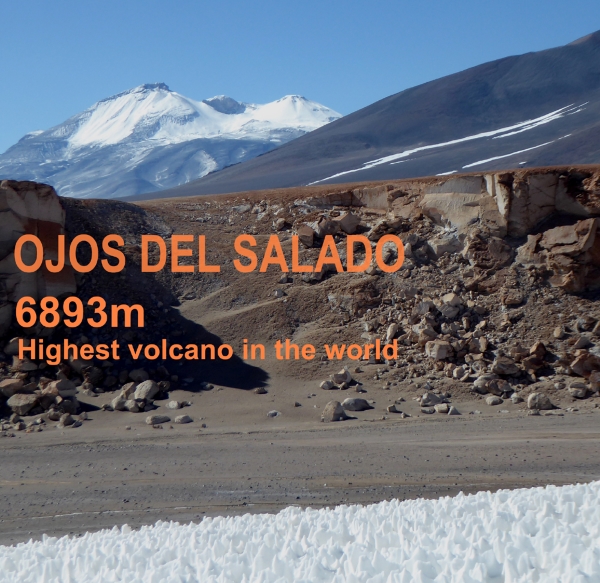
This expedition, running over Christmas and New Year 2021-22, will be based in the Puna de Atacama of Argentina. This is an area of the Andes we know very well, having run many successful trips in the past twenty years, including six successful trips to Ojos del Salado 6893m from both the Chilean and Argentine sides. The Puna de Atacama is a great area for seeing wildlife - on recent trips we have seen many condors, vicuñas, guanacos, an armadillo and even had a great view of a puma a few years ago. On our trek in to Ojos del Salado in 2021 we will walk past a cliff where ten or twenty condors regularly nest.
The expedition will fly out to the provincial capital city of Catamarca then move on to the small town of Fiambala, a sleepy place in an oasis of vineyards just a few hours drive from the mountains. After an initial acclimatisation phase of three days walking at about 3500-4500m in the Valle de Chaschuil above Fiambala we will begin our trek into the high mountains.
Our main
mountain trip will be a 10 night expedition away from civilization, using horses
to support us as far as the El Arenal base camp at 5400m, then backpacking to reach higher camps on Ojos
del Salado. Although we walk into the mountains over several days with
progressively higher camps for acclimatisation purposes, we will have a 4x4
pick us up the day after our ascent. The return drive is by a very different
route and is about an 8-hour 4x4 marathon!
From the El Arenal base camp we'll have time to make ascents of one or maybe two
nearby 6000m peaks to aid our acclimatisation. These are likely to be
Volcan del Viento 6028m and/or
Medusa 6120m. Both are straightforward ascents with great
views of our route on Ojos del Salado. We'll make the final ascent of Ojos del
Salado from a high camp at about 5900 or 6000m. This summit day is quite
likely to be on New Years Day 2022, but we have three potential summit days
in our schedule. Summit day is generally about 10-12 hours long, with all
but 2 or 3 hours of this on the ascent.
Most of the
peaks in this part of the Andes involve no technical climbing although there is a steep
snowfield on the summit day of Ojos del Salado for which an ice-axe and crampons are usually
necessary. The ascents on
this expedition are suitable for strong hillwalkers with some winter experience, previous expedition experience is preferred
as well due to the demanding weather and camping conditions. Please call or email if you have any questions about this trips suitability for
you.
Outline Itinerary |
|
| Days 1-2 | Flight via Buenos Aires to Catamarca. |
| Days 3-6 | Travel to Fiambala and acclimatisation walks. |
| Day 7 | Return to Fiambala and rest day |
| Days 8-11 | Approach trek to El Arenal base camp. |
| Days 12-14 | Acclimatisation ascents of one or two other 6000m+ peaks |
| Days 15-17 | Ojos del Salado ascent. |
| Days 18 | Drive out from the mountains |
| Days 19-20 | Travel back to Catamarca and fly home |
General Information about our holidays
Please read our warning on altitude before booking this expedition to high altitudes.
Who runs 'Andes' and where we are based
General information about equipment, accommodation, flights, meals etc.
THE PUNA DE ATACAMA
The plateau of the Puna de Atacama lies on the border between Chile and Argentina and includes a huge area over 4000m above sea level. There are still many unclimbed peaks of over 5000m in this remote area. though many of the peaks in the area were climbed at the time of the Inca empire, when the mountains were worshipped as gods by the inhabitants and were frequently ascended in order to make sacrifices. The Puna is one of the most beautiful and haunting places in the Andes, compared by many to the high plateau of Tibet. The scenery is a bit desolate for some, but the huge open spaces, clear air and big blue skies leave a deep impression on everyone who visits this area.
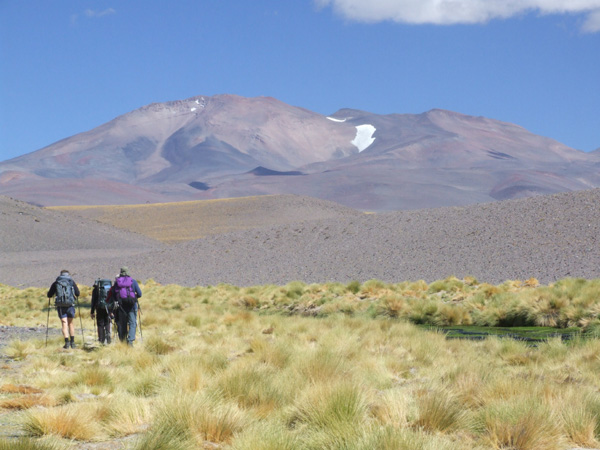
Trekking at 4000m on the approach to Ojos del Salado in 2013. The peak is the 6028m high Volcan del Viento. One of two peaks we may climb as an acclimatization peak.
CATAMARCA & FIAMBALA
Catamarca is a small provincial capital at the foot of the Andes about 500m above sea level. It is the nearest access city with an airport for the Argentine side of the Puna. We'll fly here from Buenos Aires and then spend a half day in town to purchase supplies before travelling on to the Puna de Atacama. Fiambala is a pleasant wee village set in an oasis of vineyards, wineries and olive groves in the middle of the desert and about 1500m above sea level. It is a very friendly and laid back place, with only one good restaurant - but it is a good one, doing very tasty but simple Argentine steaks and pizzas. The village is about 4 or 5 hours drive across the desert from the city of Catamarca. Nearby are some hot springs, which we may have time to visit one afternoon.
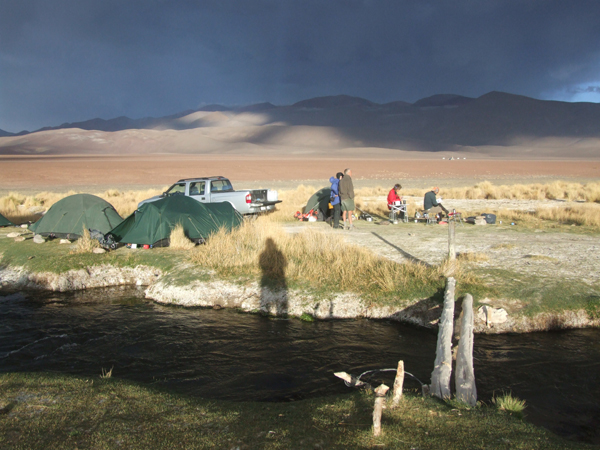
Acclimatisation camp at 3500m in the Valle de Chaschuil near Fiambala. We saw a Puma near here the next day.
WILDLIFE
Despite the fact that at first sight there is almost nothing to eat in the high barren plateau of the Puna de Atacama the area is very good for seeing some of South Americas unusual wildlife, particularly on the long jeep drives into and out of the mountains. Vicuña and guanaco are wild relatives of the llama and are seen frequently. The rhea, a species of South American ostrich is also common in the foothills. On the lagoons there are flamingos and other species of birds and on this trip we can pretty much guarantee to see a condor circling the peaks. In fact on our way into Ojos del Salado we walk past a cliff where ten or twenty condors regularly nest.
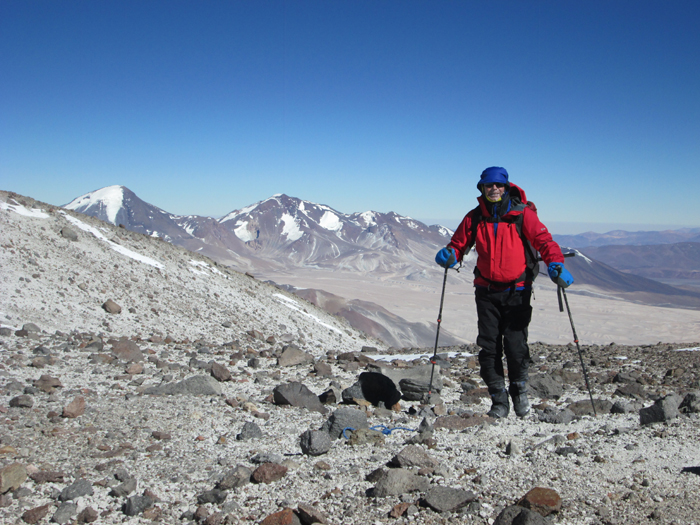
Climbing Ojos del Salado from the Chilean side, March 2016 ANDES expedition.
FITNESS & EXPERIENCE NEEDED
Although there is no difficult climbing involved in the ascents planned on this expedition, climbing to such heights is still a serious matter because of the lack of oxygen at high altitude. We will allow time for expedition members to acclimatise to the altitude, but because of the nature of the expedition we recommend clients to have previous successful experience at altitudes of 5000m+. It may be necessary to use an ice-axe and crampons on some of the peaks, particularly Ojos del Salado, but previous experience of using these is not essential.
We use mules to support the approach trek, so during those days you only need to carry a large day pack with a little emergency gear. Above base camp in the mountains we will be unsupported and therefore will have to carry expedition weight (20kg) rucksacks uphill for a day or so here and there to establish high camps on the mountains, so some recent experience of backpacking is essential.
For this expedition good mountain fitness is important, but for high altitude expeditions clients also need good cardiopulmonary (heart and lung) fitness. This can only be maintained, by a program of intensive exercise such as sprinting (not jogging), squash or sprint cycling. This should be done in small doses (e.g. half an hour every other day) over a period of at least two months
Clients should be prepared for cold nights camping and be prepared for very windy and dusty weather at times out in the mountains. You must be able to carry your own share of communal expedition equipment above base camp. As we'll be a long way from the nearest supermarket we will all have to put up with tinned and dehydrated food in our diet during our time in the desert. All clients are expected to help with the routine work of this type of expedition; pitching tents, cooking and washing up

Looking out over Chile from the summit of Ojos del Salado, March 2016 "ANDES" expedition to the Puna de Atacama.
CLIMATE
The climate at altitude in the Puna de Atacama is very cold and extremely dry. In the mountains temperatures can fall to -20ºC at night. During the day in the mountains it can feel very warm in the strong sun, but it can also be bitterly cold and windy. It should be dry all the time we are in South America, though there is a slight chance of a snow flurry in the mountains. As we are near the tropics come prepared for 10 hours of darkness every night. Temperatures in the valleys around Catamarca and Fiambala and in other low lying areas will be a very pleasant 30-35ºC during the day.
ORGANISATION & LEADERSHIP
Our expeditions are designed to be small and flexible. The expedition will be co-ordinated, organised and lead by us, but we will consult and involve the expedition members when planning the details of the trip. Please note however that the leaders decision is final where the safety of the group or any member is in jeopardy; for example where retreat or diversion is necessary due to illness or bad weather. The minimum number of customers we need to run this expedition is three. The maximum size of the expedition will be four customers plus leader.

Hotel chaos in the leaders room just before leaving for Ojos del Salado, "Andes" expedition 2013.
WHAT'S INCLUDED IN OUR PRICE AND WHAT'S NOT INCLUDED
Our price is for leadership/guiding and mountain services only. It INCLUDES the leaders fee (wages) and all their expenses, such as flights, travel, hotels, meals, permits. It also INCLUDES his or her share of communal expenses, which may be such things as 4x4 rentals, diesel and fuel, mule and porter costs, shared hotel rooms.
Our price also INCLUDES all mountain services such as provision of tents, stoves and all other communal camping equipment, all mountain food including all camp food and lunches on day trips. It also INCLUDES any communal mountaineering equipment that may be necessary, such as ropes, karabiners, etc., and on most expeditions emergency use of satellite telephone link.
Our price does NOT INCLUDE - your flights, your insurance, your hotel/hostel accommodation, your meals taken at cafes and restaurants, your share of communal travel costs (e.g. 4x4 rental, mule costs), your personal climbing and camping equipment (i.e. used by you alone, such as sleeping bag, harness, helmet), permits or peak fees payable by yourself.
INSURANCE, HEALTH & SECURITY
All clients must be insured for medical costs and repatriation in an emergency. We recommend having insurance for baggage, personal liability and cancellation as well. If you would like advice on insurance please ask. Please bring an extra copy of your insurance certificate on the expedition for the leader. Argentina is one of the most well developed countries in South America. Vaccinations for tetanus, typhoid and polio are recommended. The country is very safe and relaxing to travel in; theft and muggings are as unlikely as they are in most British cities.
SAFETY AND RISK
This is an adventure holiday and all
clients will be exposed to hazards not found in
everyday life by taking part in this itinerary. While we take all
reasonable precautions to reduce risk it is neither possible nor desirable
to completely eliminate these hazards. It is important that you understand
the hazards you may be exposed to before
signing our booking form. We have identified the following areas as the
principal additional risks of this itinerary. (Some of
these could potentially result in serious injury or death). This is
not a fully inclusive list - a more
detailed risk assessment of this itinerary is available on our
Risk Assessments page, or phone/e-mail us
and ask some questions!
Driving, hotels and general
safety : In Argentina driving, fire standards and general safety standards are
not as high as in Europe.
Extreme remoteness : You will be
camping in a very remote area for an extended period and therefore obtaining
medical assistance for any problem will be a very slow process.
Minor slips and falls : due to
steep, uneven and unstable ground.
Weather : The Puna de Atacama is
occasionally affected by severe and sometimes dangerous storms. Forecasts are
not so reliable.
Altitude : At high altitudes there is an increased risk of
medical problems, most obviously altitude illness.
Mountain Hazards : In certain places you may be subjected to
a slight risk of rock slips.
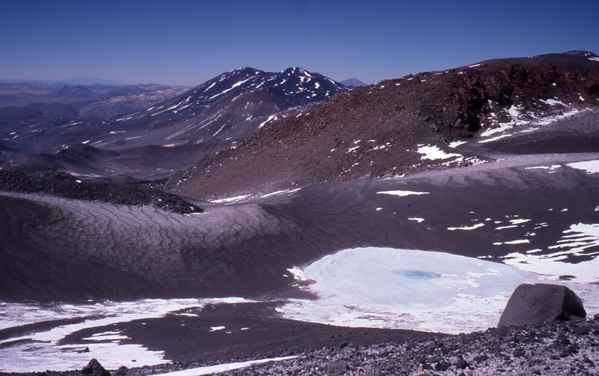
The world's highest lake sits at 6400m on the Argentine side of Ojos del Salado. We'll pass it about half-way up on our summit day.
